Former Rauschenberg Captiva Property Hit With New 47-Unit Condo Filing After $45M Sale
Last Updated: June 24, 2026
April 27, 2026 Update: New 47-Unit Condo Filing Recorded on Former Rauschenberg Property
Last Updated: April 27, 2026
A significant new post-sale development has emerged involving the former Robert Rauschenberg Captiva property.
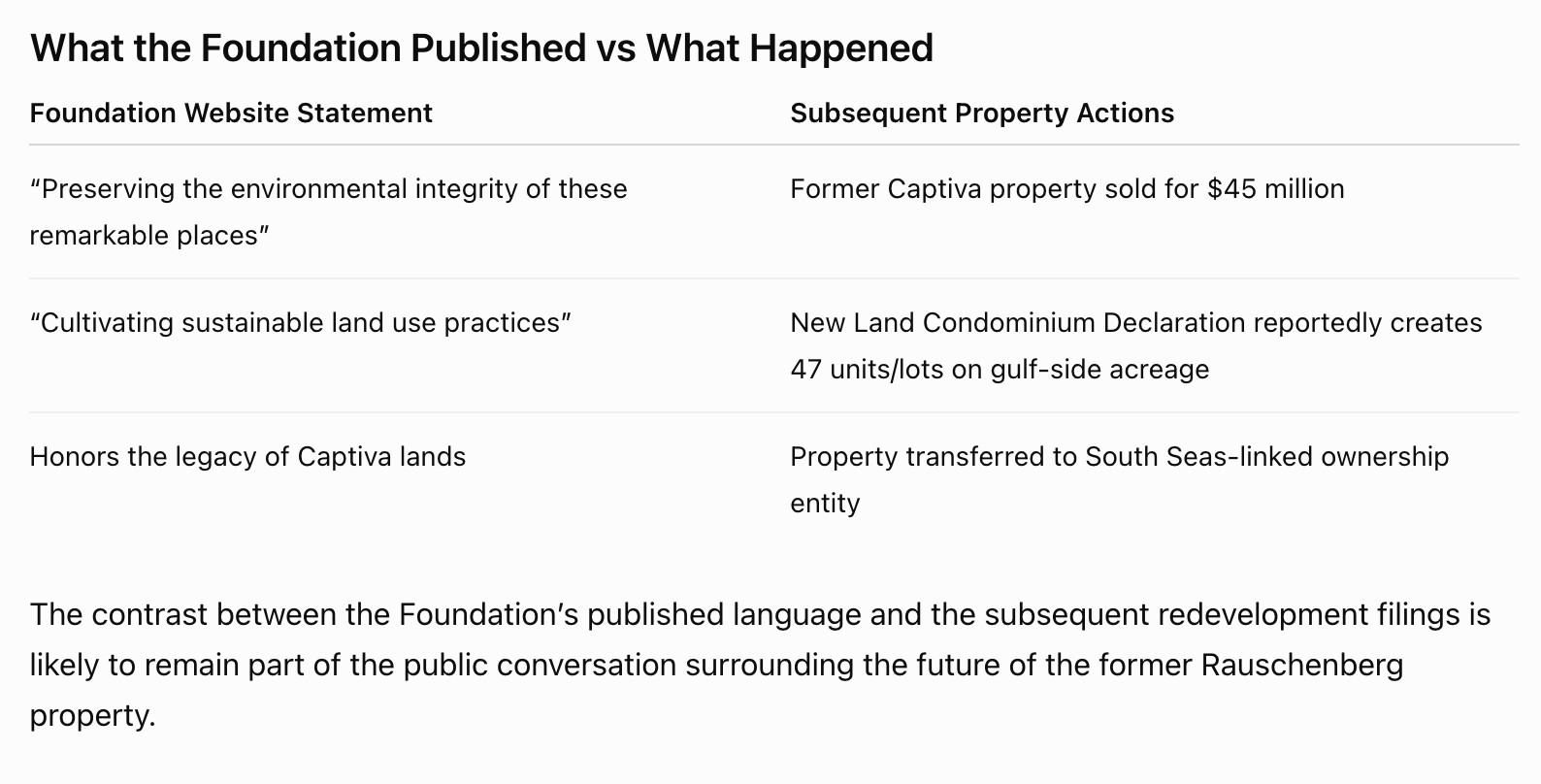
According to newly recorded property records, a Land Condominium Declaration has been filed affecting the approximate 11-acre gulf-side portion of the former 22-acre Rauschenberg estate. The filing reportedly creates 47 condominium units and lots on land that remained largely undeveloped for decades.
This is the first major redevelopment filing tied to the property since its $45 million sale earlier this year to WS SSIR OWNER TWO LLC, an entity associated with the ownership structure behind South Seas Island Resort.
The filing is expected to generate renewed public attention because of Robert Rauschenberg’s long-standing efforts to preserve the environmental character of Captiva Island.
Robert Rauschenberg’s Captiva Legacy: 22-Acre Property Sold for $45M to South Seas–Linked Ownership Entity
Foundation’s Published Sustainability Statement Draws New Attention
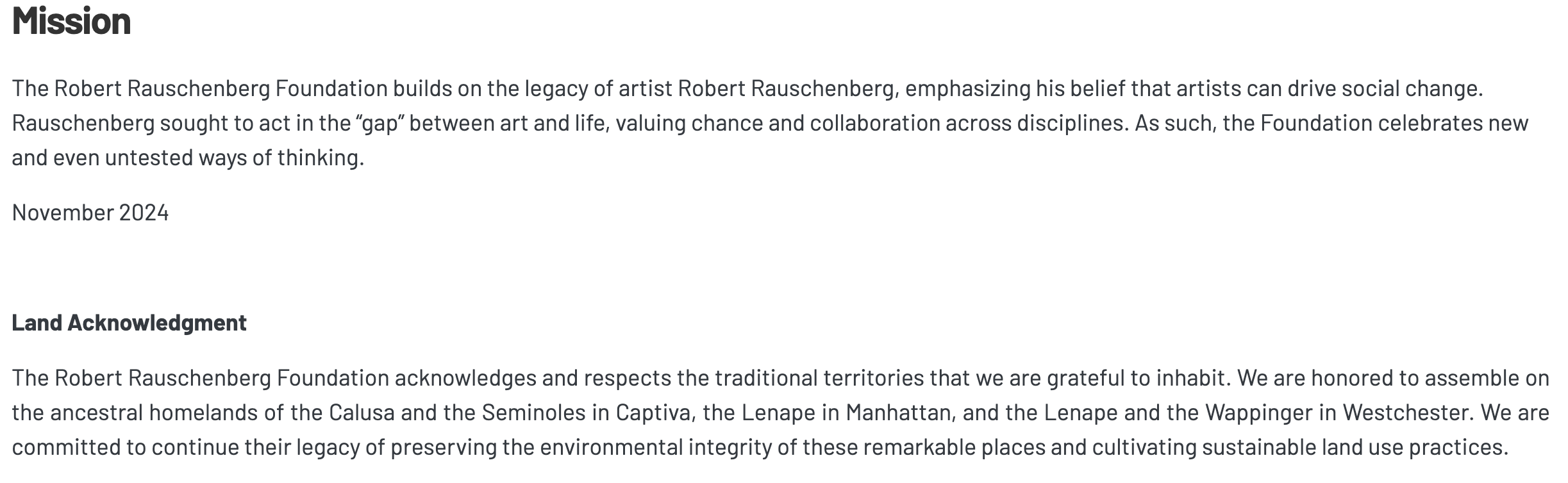
The Robert Rauschenberg Foundation states on its official website that it is committed to environmental stewardship and sustainable land use practices.
In its published Land Acknowledgment, the Foundation writes:
“We are committed to continue their legacy of preserving the environmental integrity of these remarkable places and cultivating sustainable land use practices.”
Source:
Robert Rauschenberg Foundation – Mission & Land Acknowledgment
This published language may receive renewed attention following the sale of the former Rauschenberg Captiva property and subsequent redevelopment filings affecting the site.
Screenshot shown below is from the Robert Rauschenberg Foundation website (Mission & Land Acknowledgment page), viewed April 27, 2026:
April 6, 2026 Update: Sale Confirmed Buyer Identified
Last Updated: April 6, 2026
The sale of Robert Rauschenberg’s Captiva Island property has now been officially confirmed through Lee County public records. This transaction has been verified through Lee County Official Records (Instrument #2026000083930) and independent reporting.
According to a recorded Special Warranty Deed, the 22-acre Gulf-to-Bay estate sold for $45,000,000, with the transaction closing on March 31, 2026 and recorded on April 2, 2026.
The buyer is listed as WS SSIR OWNER TWO LLC, a Delaware-based entity. The transaction is recorded under Instrument #2026000083930 in Lee County Official Records.
The seller is identified as Rauschenberg Captiva LLC / Robert Rauschenberg Foundation, formally transferring ownership of the property out of foundation control.
Originally listed for sale in 2025, the property quickly became one of the most closely followed real estate listings on Captiva Island.
What Was the Rauschenberg Captiva Property?
Before the sale, the Rauschenberg property was widely known as one of the last remaining Gulf-to-Bay estates on Captiva Island — often described as a private artist sanctuary and preservation-focused compound assembled over decades.
The property gained national attention when it was first listed for sale in 2025, drawing interest from preservation groups, public entities, and private buyers.
Independent Reporting Confirms the Sale
Independent reporting has also confirmed the transaction and buyer alignment.
Local coverage has identified the purchase as being completed by a joint venture associated with South Seas Island Resort ownership, further aligning with the recorded buyer entity listed in Lee County records.
Confirmed Sale Details from Lee County Official Records
The following details are verified through recorded public documents:
Sale Price: $45,000,000
Closing Date: March 31, 2026
Recording Date: April 2, 2026
Seller: Rauschenberg Captiva LLC / Robert Rauschenberg Foundation
Buyer: WS SSIR OWNER TWO LLC
Instrument Number: 2026000083930
Document Type: Special Warranty Deed
This transaction has been verified through Lee County Official Records (Instrument #2026000083930).
Who Is WS SSIR OWNER TWO LLC?
The buyer, WS SSIR OWNER TWO LLC, is a Delaware limited liability company with a listed address of 660 Steamboat Road, Greenwich, Connecticut.
The entity name (“SSIR”) and associated address align with ownership structures connected to South Seas Island Resort. The Greenwich, Connecticut address is consistent with entities associated with Wheelock Street Capital, an investment firm known to be involved in resort ownership structures on Captiva.
The recorded deed identifies the legal buyer as WS SSIR OWNER TWO LLC. Any further ownership relationships would be reflected through corporate filings or disclosures beyond the deed itself.
What South Seas Has Said About the Purchase
South Seas ownership has described the acquisition as:
“a rare and compelling opportunity… creating a seamless opportunity for integration and enhancements to the overall resort.”
Officials have also indicated interest in incorporating elements of the property into future resort planning, while exploring ways to honor Rauschenberg’s artistic legacy.
No formal development plans have been released.
A Property Unlike Any Other on Captiva Island
Robert Rauschenberg began assembling his Captiva property in 1968, eventually creating one of the most unique land holdings on the island.
The estate spans approximately 22 acres and extends from the Gulf of Mexico to Pine Island Sound — a configuration that is exceptionally rare on Captiva Island.
The property includes multiple structures, artist studios, residential buildings, and historically significant elements, including the Fish House associated with conservationist Jay Norwood “Ding” Darling.
Why Robert Rauschenberg Assembled This Property
Rauschenberg’s approach to land ownership on Captiva focused on preservation rather than development.
As development pressures increased on the island, he acquired adjacent parcels over time, creating a continuous stretch of land rather than subdividing it.
This approach maintained native vegetation, shoreline integrity, and lower density compared to surrounding areas.
“I have watched the mangrove along the South Seas Road destroyed… all to overpopulate and strain an already delicate balance.”
— Robert Rauschenberg, 1977 (as published in a local newspaper)
Documented Purchase Timeline: How the Property Was Assembled
Public records from the Lee County Property Appraiser confirm that the Rauschenberg estate was assembled through multiple acquisitions over several decades.
July 1968 — 11558/560 Laika Lane
January 1969 — STRAP: 26-45-21-02-00002.0330
October 1971 — 14846/850 Captiva Drive
January 1973 — 11554 Laika Lane
December 1991 — 14837 and 14845 Captiva Drive
March 1992 — STRAP: 26-45-21-00-00003.0010
April 1995 — 14840 Captiva Drive
Additionally, 11504 Laika Lane was combined with another parcel in June 2021.
Many transactions were recorded at nominal values (often $100), which is typical of internal transfers or estate structuring.
These acquisition dates and parcel records can be verified through the Lee County Property Appraiser using owner records associated with Rauschenberg Captiva LLC.
Verified Parcel Locations: Gulf-to-Bay Configuration
The property includes multiple parcels across both sides of Captiva Island.
Gulf-Side (Captiva Drive):
14837 Captiva Drive
14840 Captiva Drive
14845 Captiva Drive
14846 Captiva Drive
Bay-Side (Laika Lane):
11504 Laika Lane
11554 Laika Lane
11558/560 Laika Lane
Additional parcels include government lots and interior connections that form a continuous Gulf-to-Bay footprint.
Visual Overview of the Property
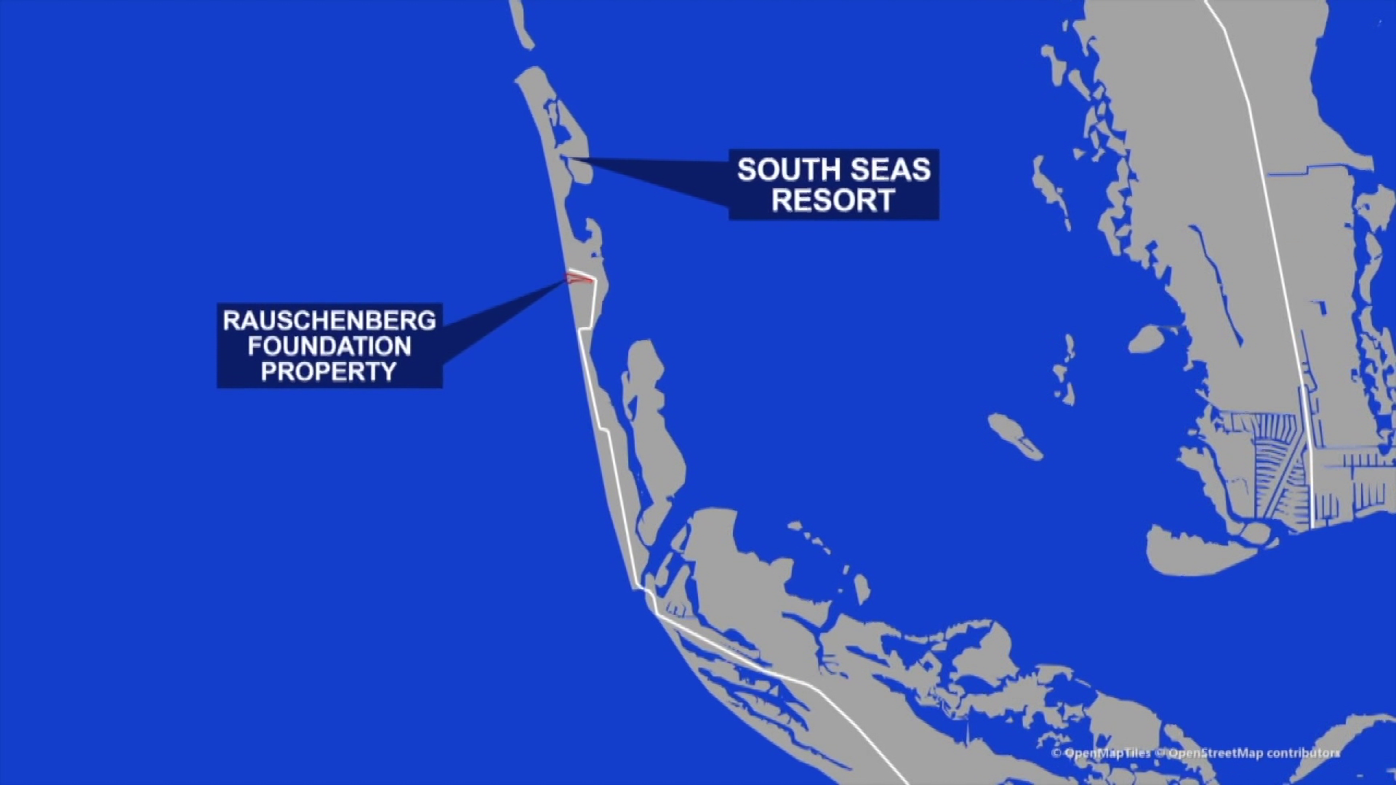
Image: Map of Captiva Island showing Rauschenberg property location and South Seas Resort (© OpenMapTiles © OpenStreetMap contributors)
From Preservation to Private Ownership
For decades, the Rauschenberg property remained under private ownership with limited development.
Following Rauschenberg’s passing in 2008, the property was managed by the Robert Rauschenberg Foundation and used for an artist residency program.
The recorded sale transfers ownership to a private entity and concludes the foundation’s ownership of the property.
What We Know vs What We Don’t Know
What We Know
The property has been sold and recorded in Lee County Official Records
The sale price is $45,000,000
The buyer is WS SSIR OWNER TWO LLC
The transaction closed March 31, 2026 and recorded April 2, 2026
The property consists of multiple parcels forming a Gulf-to-Bay estate
What We Don’t Know
Any specific development plans for the property
Whether any portion of the land will be preserved
The future of existing structures, including the Fish House
Whether the property will be integrated into broader resort operations
Any agreements related to public or emergency use
Frequently Asked Questions
What happened to the Rauschenberg property on Captiva?
The property was sold for $45,000,000 and recorded on April 2, 2026 in Lee County Official Records under Instrument #2026000083930.
Who bought the Rauschenberg Captiva property?
The buyer is WS SSIR OWNER TWO LLC, as identified in the recorded deed.
How much did the property sell for?
The recorded deed confirms a sale price of $45,000,000.
What happens to Ding Darling’s historic Fish House?
The future of the Fish House has not been publicly announced.
Will the Captiva Fire Department use the property?
Any future use of the property by the Captiva Island Fire Control District for emergency services would depend on agreements with the current owner. The Captiva Island Fire Control District’s interest in approximately 9.8 acres of bayfront land associated with the broader property is vital to residents and visitors who might need to be flown out quickly for medical emergencies.
Prior public discussions identified portions of the property as strategically important for emergency helicopter operations and staging.
Emergency helicopter operations
Medical evacuation access
Disaster response staging
Long-term resilience planning
Will the property be developed?
No formal development plans have been publicly released.
Will the Captiva Artist Residency Program continue?
The Captiva artist residency program, which has brought hundreds of creatives to the island since its launch in 2012, remains scheduled to conclude in August 2026.
At this time no announcements have been made regarding:
Program relocation on Captiva
Extension beyond the current timeline
Preservation of residency infrastructure on-site
This timeline adds urgency to discussions about the future cultural footprint of the property.
What to Watch Next: Key Milestones Following the Sale
With the sale now confirmed through Lee County records, attention turns to what happens next.
Several key milestones will determine how the property may be used:
Zoning and Land Use Applications: Any request to change density, use, or zoning classifications filed with Lee County
Captiva Plan Amendments: Potential changes to development limits specific to Captiva Island
Development Orders and Site Plans: Formal proposals outlining buildings, infrastructure, and layout
Environmental Permits: Applications related to mangroves, wetlands, shoreline impacts, or dock construction
Public Safety Agreements: Any future coordination with the Captiva Island Fire Control District for emergency access
Legal or Community Challenges: Potential opposition or legal action tied to development proposals
These steps typically occur before any physical changes to a property and will provide the earliest indication of how the site may evolve. Each of these will significantly impact Captiva’s environmental, cultural, and development landscape.
A Defining Decision for Captiva’s Future
The sale of Robert Rauschenberg’s Captiva property is more than a real estate transaction. It represents a defining moment for island stewardship, coastal preservation, and cultural heritage.
This chapter has closed and the eyes of residents, conservation advocates, and the broader Southwest Florida community remain fixed on what happens next. Hidden between the Gulf of Mexico and Pine Island Sound, the late Robert Rauschenberg’s Captiva Island property has long been one of Southwest Florida’s most extraordinary coastal landmarks — a place where art, nature, and solitude blended in perfect harmony. Now, for the first time in over fifty years, this world-renowned estate has sold, drawing global attention and sparking passionate local conversation about its future.
How this land is managed next will shape:
Environmental protection outcomes
Emergency infrastructure capabilities
Community character
Development pressure patterns
Captiva’s long-term identity
Final Thoughts: A Turning Point for Captiva
For decades, this property was assembled and held as a continuous tract of land spanning the island.
The recorded transfer of ownership marks a significant change in the history of the property and establishes a new phase in how the land may be used in the future.
The Way We Were
An Artist’s Vision Meets Island Life
When Robert Rauschenberg, one of the most celebrated figures in modern American art, first arrived on Captiva Island in the early 1970s, he found something that New York and the art world could not offer: space, light, and freedom. Over time, he transformed his coastal retreat into an artistic refuge — expanding his holdings to include more than 20 acres of Captiva beachfront and bayfront land, dotted with cottages, studios, rich with history.
For decades, this sanctuary inspired Rauschenberg’s creativity and became a cornerstone of his legacy. After his passing in 2008, the Robert Rauschenberg Foundation carried that legacy forward by establishing an artist residency program, hosting creators from around the world who found inspiration in Captiva’s natural rhythm.
Balancing Legacy, Preservation, and Progress
The sale of the Rauschenberg property underscores an ongoing challenge for barrier island communities: how to honor history and protect the environment while embracing thoughtful growth. With much of Captiva zoned for low-density residential and conservation use, the property’s future could profoundly influence not only local real estate values but also the character of Captiva’s north end.
A Legacy That Endures
One truth remains: Robert Rauschenberg’s spirit is woven into Captiva’s landscape. His creative energy, his respect for nature, and his belief in artistic exploration continue to shape the island’s story.
For those who love Captiva — or dream of owning a piece of its history — this moment represents both an ending and a beginning. It’s a testament to the island’s enduring beauty, its cultural depth, and the community’s shared determination to protect what truly matters.